
Maka-Diyos: A Belief in Something Greater

Updated: Aug 10
Walk By Faith
On my kitchen refrigerator is a magnet that says "Walk by Faith" (2 Corinthians 5:7). Next to it is a magnet I picked up at the Manila Cathedral (Minor Basilica of the Immaculate Conception) during my travels. It is an image of Our Lady of Guadalupe, the Heavenly Patroness of the Philippines. It also happens to be the image of Mary, the Mother of Christ, that I am most drawn to. Her image was frequently visible in the Philippines. Even in the most unexpected of places, like public schools.

Because of the separation of church and state in the United States, I was initially surprised when I saw and heard Christian references in public schools. The image to the left, for example, was hanging in a prominent hallway not too far from the administrative offices in a public high school. It's not just displayed; it is adorned and admired. There are flowers and greenery offered to Mary as an indication of worship and acknowledgement of her presence. I can only imagine the uproar that would occur if that was the case at a public school in the U.S. And so, as we settled into our introductory meeting at the school, I had questions to ask about the role of religion and spirituality in the Filipino education system. And why, for something that seemed so controversial to me, it was encouraged in the Philippines.
Maka-Diyos
I did not have to wait long for a response. As we were learning about the school and its offerings, the four core values in their Values-Based Education curriculum were highlighted. The first value? Maka-Diyos. At face value, it means "God-fearing" or "God-centered". And it is evident in schools that Maka-Diyos is an established value. From images hung in hallways, to starting classes with student-led prayer, and prayers and songs that mention God during their civics assemblies, the belief of Maka-Diyos is not just taught, but actively practiced. And for me, as a Roman Catholic, that is a beautiful thing.
According to the Philippine Statistics Authority, 78.8% of Filipinos identify as Roman Catholic. It is the third largest Catholic nation in the world behind Brazil and Mexico. So it seems natural that the principle value would be one of faith. But what about those who are not Catholic? How do they feel about a value that makes God the center?
More than Religion
A deeper look into Maka-Diyos answers that question. There are two behavior statements under the value of Maka-Diyos that are supposed to guide teaching and learning. Maka-Diyos means
expressing one's spiritual beliefs while respecting the spiritual beliefs of others, and
adhering to ethical principles by upholding truth.
Maka-Diyos is not the belief that there is only one way to be Filipino. It is meant to include a variety of spiritual practices including indigenous practices and other world religions.
As visiting teachers, we had the opportunity to meet with members of the Muslim community at Oro Site High School. We were able to talk briefly with students and have lunch with Muslim leaders of the local mosque. Through them we were able to gain a deeper understanding of what it means to be a Muslim student in a predominantly Christian environment. I asked them if they felt oppressed or limited in practicing their beliefs and they responded that they did not feel pressured and that they felt respected even though their beliefs differ.
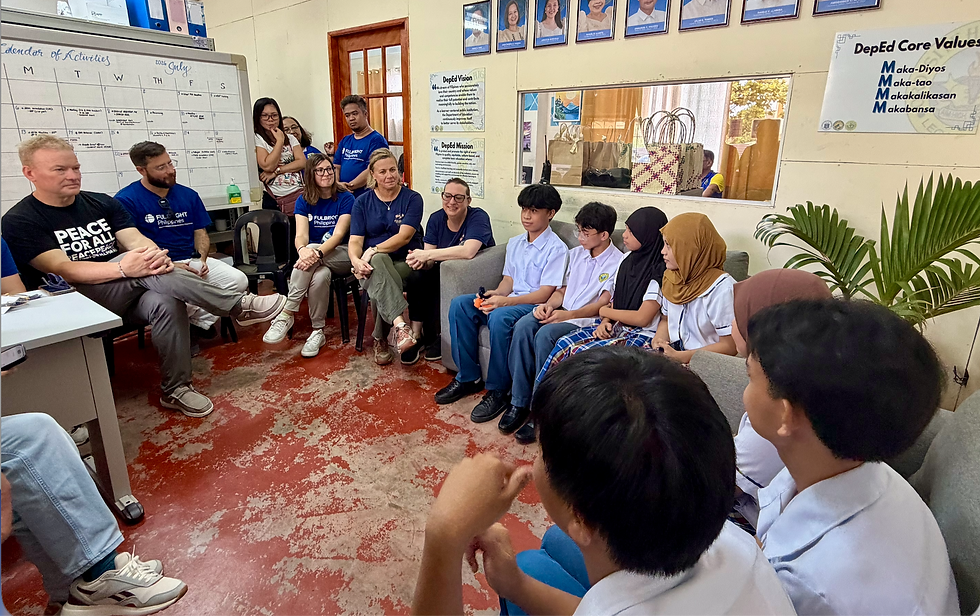
I believe that is because the first behavior statement for Maka-Diyos includes guidance on how that looks in action. These include
engaging oneself in worthwhile spiritual activities
respecting sacred places
respecting religious beliefs of others
demonstrating curiosity and willingness to learn about other ways to express spiritual life.
Experiencing the respect of and curiosity for others' differences in the Philippines has a left a mark on my heart. Not only because of my experiences in the schools but also because of experiences I shared with colleagues.
Curiosity & Conversation
As a teacher, my time in the Philippines highlighted the power of spirituality in personal growth and education. It teaches us Maka-Diyos - that there is something bigger to hold on to.
As a individual my time there deepened my own belief system through reflection and experiences that I shared with colleagues. Being able to visit churches that have played a profound role in the shaping of local culture was humbling at times. In addition to the Manila Cathedral, we visited Daraga's Nuestra Señora de la Portería Parish Church. Dropped against scenic Mt. Mayon, I was able to admire its beauty and refresh my soul with prayer. I was also able to visit the Cagsawa Ruins. Villagers fled here during a volcanic eruption in 1814. Safety was elusive and much of the church and the villagers remain entombed below the surface.

More important for my soul and faith though were the conversations I had with fellow Fulbright teachers. Not all of the same faith, we took time to learn from each other about our perspective religions. A couple of them even attended Mass with me when we returned to Manila the final weekend. The discussions and sharing that occurred showed me just how important the curiosity that is encouraged through Maka-Diyos can be. It deepened my faith and allowed me to better understand those who are different from me.
If my journey to become a global educator has taught me anything, it is that respecting the beliefs of others that differ from your own beliefs and being curious and willing to learn about those differences, is key to developing global competence. Let us "Walk by Faith" everyday that through spiritual understanding and respect for others, we can make the world a better place for all.


Comments